
The RECOVER
Research Strategy
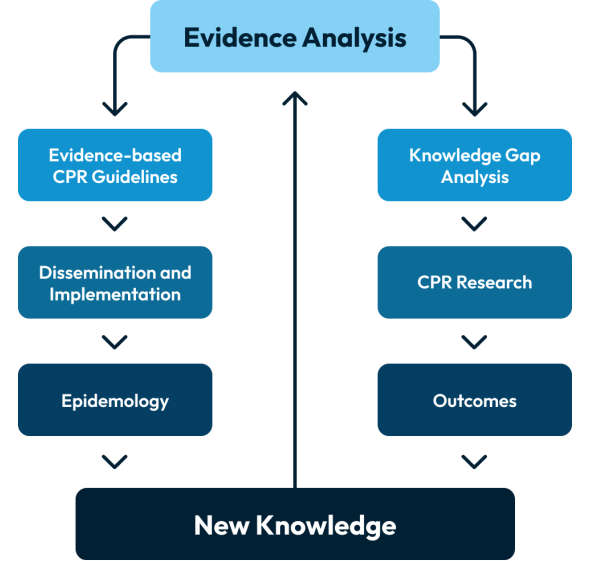
A Cycle of Evidence Analysis and Creation of New Knowledge
The RECOVER evidence evaluation for CPR and Newborn Resuscitation Guidelines identified numerous gaps in existing scientific knowledge. These gaps created significant uncertainty in treatment recommendations. As a result, a key objective of the RECOVER systematic literature review process is not only to evaluate available evidence, but also to identify important knowledge gaps and promote research to address them.
RECOVER actively supports research through multiple initiatives, including the provision of funding (such as the CPR Pilot Grant and the CPR Knowledge Gap Grant for interventional research) and the administration of the RECOVER CPR Registry. The generation of new knowledge through these efforts will improve our understanding of how best to perform CPR in veterinary patients and will inform future treatment recommendations.
For these recommendations to have a meaningful impact, they must be effectively implemented in clinical practice. To support this, RECOVER employs both passive and active dissemination strategies. Passive strategies include free public access to the guidelines and their translation into multiple languages. Active strategies include online and in-person training programs, competency-based assessments, and outreach activities for community engagement.
Epidemiological studies are needed to determine whether RECOVER guidelines are being adopted in clinical practice, the extent of their implementation, and the benefits they provide to veterinary patients undergoing CPR. The RECOVER CPR Registry is one instrument to obtain large scale observational clinical data across a wide range of practice settings.
New knowledge generated through these combined efforts is expected to strengthen future treatment recommendations and enhance their translation into clinical practice through improvements in the areas of teaching and learning.
RECOVER supports CPR research in many ways:
- Identification and prioritizing of knowledge gaps.
- Research funding through annual RECOVER grants.
- Establishment and operation of a CPR registry.
- Provision of uniform reporting guidelines and data reporting templates to harmonize clinical veterinary CPR research.
- RECOVER CPR App with functionality as case-report form for real-time data collection.
- Generation of a printable CPR case-report form for collection of clinical CPR data.
- Knowledge Gaps
- Operational Definitions
- Case-Report Form
- CPR Registry
- Multicentre CPR Studies
- Trial Funding
Identification and prioritizing of knowledge gaps.
Numerous knowledge gaps emerged from the 2012 and 2024 systematic literature reviews. The RECOVER Research Committee is collating these knowledge gaps in a separate document and is prioritizing them according to perceived impact on critical outcomes based on expert consensus. The aim of this is to provide a rational for veterinary resuscitation researchers to coordinate their research and to take a systematic approach to applying resources towards addressing high-priority knowledge gaps first.
Provision of unambiguous operational definitions and data reporting templates to be used in clinical veterinary CPR research.
A common CPR terminology is critically important for efficient communication amongst resuscitation researchers and for undertaking collaborative studies. Unambiguous operational definitions for terms used in veterinary CPR research studies (and really any research studies) are a prerequisite for the collection of high-quality data.
In 2013, the RECOVER initiative brought together an international group of veterinary emergency and critical care experts, including representatives of the veterinary critical care organizations VECCS, ACVECC, EVECCS, LAVECCS and JSVAS and the International Liaison Committee on Resuscitation (ILCOR). During a 3-day retreat and by standard consensus finding methodology, this group developed guidelines for uniform reporting of small animal in-hospital CPR events. The finalized consensus guidelines, the so-called Utstein-style guidelines on standardized reporting of CPR events in dogs and cats, were published in 2016 in the Journal of Veterinary Emergency and Critical Care. The document contains an explicit list of definitions for veterinary CPR terminology. It also proposes key data elements to be included in clinical veterinary CPR studies and in research reports. It is the hope of the RECOVER initiative that these guidelines serve as an effective instrument to elevate the quality of small CPR research, to allow data comparison across studies and to foster collaborative research. A clear veterinary data collection framework is also the pre-condition for establishing long-term CPR data repository projects (i.e., CPR registry).
Generation of a CPR case-report form for collection of clinical CPR data
Given the unexpected nature of cardiopulmonary arrest, the collection of high-quality clinical data on resuscitation events is challenging. In the absence of technology to facilitate the real-time collection of data, most veterinary CPR research depends on manually recording clinical CPR event details on an electronic or paper case report form. RECOVER recognized that the design of this CPR case report form (CRF) can be instrumental in improving data collection or for enrolment of CPR cases in studies altogether. A CPR CRF task force was therefore brought to life in late 2017 and was chartered with developing a user-friendly CRF that improves collection of CPR variables of core importance as per the Utstein-style guidelines. Reliable collection of these data is crucial for a meaningful interpretation of CPR events.
Establishment and operation of a CPR registry
A registry is a health-related database containing demographic and clinical information of individual animals and serving a specific health-related purpose. Registries are used for long-term data collection, while observational research projects focus on short-term data gathering.
The RECOVER Registry Committee is chartered to develop and maintain the RECOVER CPR Registry. The registry contains more than 1000 cases. If you consider to contribute your hospital’s cases, we are continuously responding to expressions of interests.
This 2026 article in the Journal of Veterinary Emergency and Critical Care will provide more information on the Registry as well as a data summary.
Coordinative support for prospective multicentre CPR studies
Conducting prospective clinical studies involving CPR is complicated by the unexpected nature of cardiopulmonary arrest and by the low number of animals that survive to be assessed for functional outcome. A single veterinary center is therefore unlikely to generate adequately powered clinical trials in a meaningful time frame and multicenter studies are a pre-condition for interventional (and probably observational) studies of acceptable quality. RECOVER therefore strongly encourages that investigators collaborate with multiple groups to answer their research questions. The RECOVER Research group aims to support the process by providing study design support and access to electronic data collection instruments. A RECOVER Trials Committee is now being formed to help to coordinate multicenter CPR studies.
RECOVER Trial Funding
Lack of funding constitutes a significant impediment to any clinical research in veterinary medicine and CPR research is unfortunately no exception. RECOVER aims to generate funding to support CPR research in a competitive manner. The RECOVER Trials Committee is appointed to explore funding options for this purpose and, once available, to administer the allocation of CPR research support via a grant application process.


